
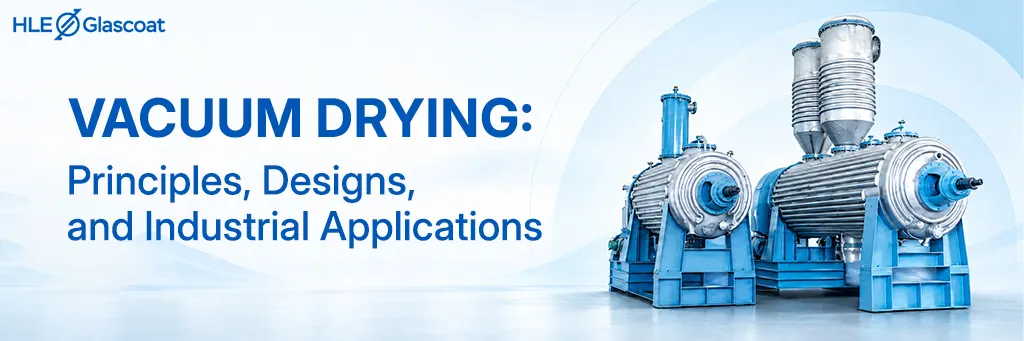
Vacuum drying is used in industrial processes where wet cake or solution needs to be converted into dry
powder. HLE Glascoat offers a range of filtration and drying equipment designed for different process requirements, including the Rotary Vacuum Paddle Dryer (RVPD), Agitated Nutsche Filter-Dryer (ANFD), Heli Cone Dryer (HCD), Orbicular Dryer, Glass-Lined Rotary Conical Vacuum Dryer (RCVD) and Rapid Disc Dryer-Cooler (RDDC).
Selecting Equipment for the Process
Dryer selection depends on the material being processed, the operations required, the desired product condition and equipment-specific design requirements. The equipment in HLE Glascoat’s portfolio is not interchangeable: each design has features intended to address particular process and handling needs.
Rotary Vacuum Paddle Dryer (RVPD)
HLE’s RVPD is a batch vacuum dryer used to obtain dry powder from wet cake or solution. The brochure also lists low-temperature drying, reaction, crystallisation, solvent recovery, mixing, blending and extraction of useful liquids among its applications. Its design includes a hollow shaft with paddle agitation, heating using steam or hot liquid, a product filter and scraper-related features. The brochure describes the paddle arrangement as supporting heat transfer, tumbling and agitation.
Agitated Nutsche Filter-Dryer (ANFD)
The ANFD combines filtration, washing, re-slurrying and drying in a single charge in a fully enclosed vessel. HLE’s Intelligent ANFD adds microprocessor-based automation, sensors, a local operating panel, data exchange with DCS/SCADA systems, optional control of peripheral equipment and manual override. The brochure describes potential benefits in process control and cycle optimisation; results depend on the application.
Heli Cone Dryer (HCD)
HLE’s HCD is designed for powders, suspensions, pastes and high-viscosity materials. Its vertical conical vessel uses a heated helix impeller and shaft. The brochure describes low-speed, low-shear mixing for gentle handling and also identifies an optional chopper for applications requiring additional deagglomeration.
Orbicular Dryer
The Orbicular Dryer is presented for sensitive pharmaceutical products where access for inspection and cleaning is important. Its spherical vessel can be opened at the lower half to provide access to internal surfaces.
The brochure also describes CIP/SIP spray nozzles, a heated agitator and a bottom discharge arrangement designed to minimise product hold-up.
Rapid Disc Dryer-Cooler (RDDC)
The RDDC is designed for drying wet cake or solution and can cool the dried powder before discharge. Instead of relying only on paddles, it uses specially designed heated discs to increase heat-transfer area. A scraper mechanism moves dried powder towards the outlet. HLE’s official company material describes the RDDC as capable of nearly doubling capacity within the same footprint and volumetric capacity; actual performance depends on the application and equipment configuration.
Glass-Lined Rotary Conical Vacuum Dryer (RCVD)
HLE also offers a Glass-Lined Rotary Conical Vacuum Dryer. The supplied brochure provides model-specific dimensional and technical information. Suitability should be assessed against the intended material and process requirements.
Key Considerations When Selecting a Dryer
- Material characteristics: Consider the feed form and how it behaves during mixing and drying.
- Required process steps: Determine whether the process requires drying alone or a combination of filtration, washing, re-slurrying, crystallisation or other operations listed for the equipment.
- Heat transfer and agitation: Compare the equipment’s stated design features with the needs of the process.
- Discharge and cleaning: Review the design features described for product discharge, access, inspection and cleaning.
- Automation: Where relevant, consider the Intelligent ANFD features described by HLE, including sensors and DCS/SCADA data exchange.
Frequently Asked Questions
Q: What is vacuum drying used for?
A: HLE’s RVPD brochure lists batch drying of wet cake or solution, as well as low-temperature drying, reaction, crystallisation, solvent recovery, mixing, blending and extraction of useful liquids.
Q: What is the difference between an RVPD and an ANFD?
A: The RVPD is described as a batch vacuum dryer for wet cake or solution. The ANFD combines filtration, washing, re-slurrying and drying in one charge in a fully enclosed vessel.
Q: How does the RDDC differ from a paddle dryer?
A: The RDDC uses specially designed heated discs to increase heat-transfer area and includes scrapers to move dried powder towards the outlet.
Discuss your process requirements with HLE Glascoat’s Filtration and Drying team to identify the equipment that best matches your application.