
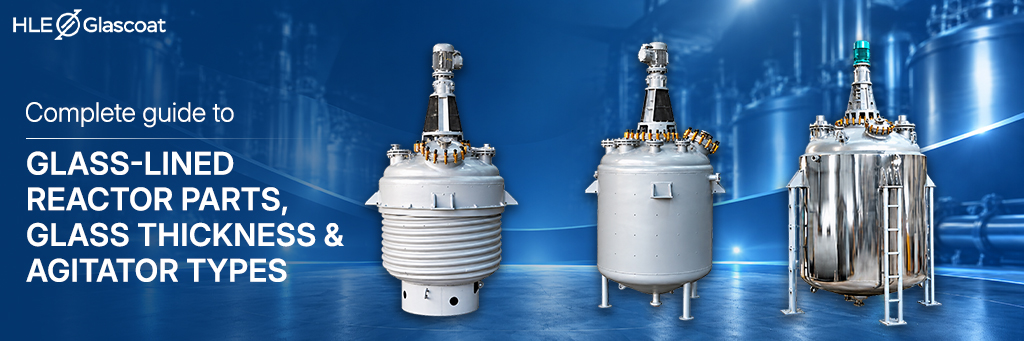
Corrosion and contamination. These are two major problems with reactor parts. A glass-lined reactor (GLR) is the solution for this exact problem. It has the mechanical strength of steel and the corrosion resistance of a specialized glass/enamel lining, along with its chemical inertness.
Every component contributes to the reactor’s performance, reliability and service life. Whether it’s the vessel shell, glass lining, agitator, jacket, nozzles, baffles or mechanical seal.
For chemical, pharmaceutical, agrochemical and other corrosion-sensitive processes, selecting the right glass-lined reactor requires specific vessel capacity, vessel configuration, process conditions, glass formulation, agitation requirements, heat-transfer requirements and applicable design standards.
This guide explains the major components of a glass-lined reactor, how glass-lining thickness is specified and inspected, the role of DIN standards, and how different agitator configurations suit different process requirements.
What Is a Glass-Lined Reactor?
A glass-lined reactor is a steel process vessel whose product-contact surfaces are protected by a specially formulated glass/enamel lining. The lining is applied to the prepared steel surface and fired at high temperature to create a durable bond between the glass and steel.
The steel provides the mechanical strength required for pressure and vacuum service, while the glass lining provides corrosion resistance and a chemically inert process-contact surface.
This combination makes GLRs particularly suitable for processes involving corrosive chemicals, organic solvents and purity-sensitive products.
Also, the selection of glass formulation is application-dependent. Chemical compatibility should always be evaluated against the specific process medium, concentration, operating temperature and exposure conditions rather than relying on pH alone.
HLE Glascoat offers GLR configurations including AE, BE and CE types, with different capacities, glass formulations and agitator arrangements to suit process requirements.
Key Glass-Lined Reactor Parts
Understanding the major components of a GLR helps process engineers evaluate equipment specifications, maintenance requirements and long-term operating performance.
1. Steel Shell
The steel vessel provides the primary mechanical strength of the reactor. Depending on project requirements and jurisdiction, the pressure boundary may be designed and fabricated according to applicable pressure-vessel codes such as ASME Section VIII or EN 13445. The required steel thickness is determined by factors including design pressure and vacuum, vessel diameter and geometry, material grade, design temperature, corrosion allowance where applicable, and the applicable design code and fabrication requirements. The glass lining does not replace the mechanical function of the steel pressure boundary.
2. Glass Lining
The glass lining is the primary corrosion-resistant process-contact surface. It is applied through a controlled enamelling process involving preparation of the steel surface, application of glass/enamel layers and firing at high temperature. The resulting glass-to-steel bond provides a smooth, corrosion-resistant surface suitable for demanding chemical processes.
3. Jacket and Heat-Transfer System
Temperature control is critical in batch chemical and pharmaceutical processes. A GLR may be equipped with a jacket or other heat-transfer arrangement designed to circulate steam, hot water, cooling water, chilled water or brine, or thermal oil. The jacket configuration and heat-transfer area are selected according to the process duty, utility conditions, allowable pressure and required temperature-control performance. Conventional jackets and half-pipe/half-coil arrangements may be used depending on the design.
4. Agitator Assembly
The agitator is one of the most important process components in a GLR. Its design influences mixing and circulation, heat-transfer performance, solid suspension, gas dispersion, liquid-liquid dispersion and reaction uniformity. The correct agitator should therefore be selected based on the mixing objective and process characteristics, rather than viscosity alone.
5. Nozzles and Manways
GLRs incorporate nozzles and openings for raw-material charging, instrumentation, temperature and pressure measurement, pH measurement, sampling, dip pipes, reflux or vapour connections, cleaning arrangements and product discharge. The arrangement and dimensions of vessel nozzles are governed by applicable vessel standards and project specifications.
6. Agitator Shaft Seal
The agitator shaft enters the reactor through a sealing arrangement designed to prevent process vapour from escaping and to prevent unwanted atmospheric ingress. Depending on process requirements, seal arrangements may include single mechanical seals, double mechanical seals, dry-running arrangements and other application-specific systems. Seal selection depends on process chemistry, temperature, pressure/vacuum, shaft speed, hazardous or flammable service and emission requirements.
7. Bottom Outlet Valve
The bottom outlet provides controlled product discharge from the reactor. For pharmaceutical and high-purity processes, the outlet design should minimize product hold-up and areas where material can accumulate. Depending on the process, outlet valves may incorporate glass-lined, PTFE-lined or other corrosion-resistant process-contact surfaces.
8. Baffles
Baffles are fixed internals used to control the flow pattern generated by the agitator. They help reduce swirling and vortex formation, improve bulk circulation and mixing effectiveness, and support more uniform heat and mass transfer. For glass-lined vessels, baffles must be designed and installed without compromising the integrity of the glass lining.
Glass-Lining Thickness: What the Standard Actually Says
Glass-lining thickness is an important quality parameter, but it should not be treated as a universal fixed value for every area of a reactor.
A common misconception is that DIN 28721 prescribes values such as 1.5 mm for the cylindrical shell and 2.0–2.5 mm for the bottom. That is not an accurate representation of the current international quality standard.
ISO 28721-1:2019 specifies quality requirements and testing for glass-lined apparatus and states that enamel coating thickness on steel substrates is generally within the range of:
1.0 mm to 2.2 mm
The standard also defines specific exceptions and conditions relating to coating thickness and particular geometries. Therefore, glass thickness should be specified and verified according to the applicable standard, equipment design and manufacturer’s quality requirements, not simply assigned according to broad vessel zones.
Why Glass-Lining Thickness Matters
Corrosion protection
The glass lining separates the process medium from the steel substrate. Maintaining the specified coating thickness and integrity helps preserve this protective barrier.
Mechanical durability
Glass lining is hard and chemically resistant but inherently brittle. Its service performance depends not only on thickness but also on formulation, bond quality, surface condition, geometry and operating conditions.
Thermal performance
Glass-lined equipment is exposed to temperature changes during heating and cooling. The lining and steel substrate must be designed and operated within their allowable thermal conditions.
Service life
Proper glass formulation, manufacturing quality, inspection and operating practices all contribute to the service life of the lining.
How Is Glass-Lining Quality Inspected?
Visual Inspection
Glass-lined surfaces are visually examined for visible defects and surface condition.
High-Voltage / Spark Testing
High-voltage testing is used to identify discontinuities or defects in the glass lining that could expose the underlying steel. According to ISO 28721-1, high-voltage testing is performed in accordance with ISO 2746. After enamelling is completed, the manufacturer performs a high-voltage test at 20 kV; subsequent tests use a maximum of 12 kV, subject to the conditions specified by the standard.
Important: Spark testing is not a glass-thickness measurement. Coating thickness is checked separately using an appropriate thickness-measurement method.
ISO 28721-1 covers quality requirements, dimensional checks, performance tests and defect-repair provisions for glass-lined apparatus and components.
DIN Standards Relevant to Glass-Lined Reactors
A GLR is not governed by one single DIN standard covering every component. Different standards address different aspects of the vessel and its components.
| Standard | Primary relevance |
| DIN 28136-1 | Principal dimensions of agitator vessels |
| DIN 28136 series | Vessel configurations and nozzle arrangements |
| DIN 28131 | Agitator and baffle types, terminology and main dimensions |
| DIN 28146 | Mounting dimensions for glass-lined steel baffles |
| DIN 28151 | Jacket-nozzle positions for glass-lined agitator vessels |
| ISO 28721-1 | Quality requirements and testing of glass-lined apparatus |
DIN 28136-1 is the standard for principal dimensions of agitator vessels. ISO 28721-1 specifically addresses quality requirements and testing of glass-lined apparatus. DIN 28136 should therefore not be described as the standard that independently governs the complete design, fabrication and glass quality of every GLR component.
Glass-Lined Reactor Agitator Types
Agitator selection should begin with the process objective. The required mixing pattern may be driven by heat transfer, blending, solid suspension, gas dispersion, liquid-liquid dispersion, mass transfer or reaction kinetics.
1. Anchor Agitator
Anchor agitators follow the general contour of the vessel and operate with a controlled close clearance from the vessel wall. They are particularly useful where wall-side circulation and heat-transfer performance are important.
Typical applications: Low-to-moderate viscosity processes; wall heat-transfer applications; blending; general batch processing.
2. Retreat-Curve / Impeller Agitator
Retreat-curve impellers are widely used in glass-lined reactors and are designed to generate effective circulation while maintaining appropriate clearances from the vessel and internals. Their suitability depends on the required flow pattern, power input, vessel geometry and process conditions.
Typical applications: General chemical synthesis; pharmaceutical processing; liquid blending; heat-transfer applications; processes requiring effective bulk circulation.
3. Multi-Function Agitator
Multi-function agitators can be designed to combine different flow characteristics within one agitator system. An HLE-specific multi-function configuration may be designed to provide enhanced axial and radial circulation for applications where conventional single-flow agitators may not provide the required mixing performance.
Typical applications: Higher-viscosity processes; solid suspension; tall vessel geometries; processes requiring enhanced bulk circulation.
4. Turbine / High-Shear Impeller
Turbine-type impellers can provide higher local shear and strong radial circulation. They may be considered where intensive dispersion or mass transfer is required. High shear is not automatically desirable and its effect on product quality must be evaluated.
Typical applications: Gas-liquid dispersion; liquid-liquid dispersion; emulsification; mass-transfer applications; intensive mixing.
5. Paddle Agitator
Paddle agitators provide relatively simple, low-intensity mixing and may be suitable where gentle circulation is sufficient.
Typical applications: Liquid blending; dissolution; low-viscosity batch processes; gentle mixing operations.
How Do AE, BE and CE Glass-Lined Reactors Differ?
AE, BE and CE are standardized vessel construction forms associated with the DIN 28136 family. A key distinction between these configurations is their construction and access arrangement, not simply the agitator entry position.
AE Type
AE reactors use a two-piece construction, consisting of the vessel body and a separate cover. This configuration provides convenient access to vessel internals and can be advantageous where inspection, cleaning or maintenance access is important.
BE Type
BE reactors use a one-piece vessel construction without an assembly cover. Access is provided through the available manways and nozzles. This configuration can provide a compact vessel arrangement while supporting larger process capacities.
CE Type
CE reactors use a one-piece construction with an assembly cover. The assembly opening provides access for installation of appropriate agitator and internal components while retaining the structural characteristics of the one-piece vessel construction.
| Feature | AE | BE | CE |
| Construction | Two-piece | One-piece | One-piece with assembly cover |
| Vessel access | Main cover provides extensive access | Through manways/nozzles | Assembly cover + access openings |
| Typical consideration | Easy access and maintenance | Compact one-piece construction | Large-vessel/internal installation requirements |
| Agitator selection | Process-dependent | Process-dependent | Process-dependent |
| DIN basis | DIN 28136 family | DIN 28136 family | DIN 28136 family |
How to Select the Right Glass-Lined Reactor
Selecting a GLR should begin with the process rather than vessel capacity alone.
Process chemistry: Identify chemicals, concentrations, impurities and potential corrosive species.
Operating temperature: Consider reaction temperature, heating/cooling cycles and potential thermal excursions.
Pressure and vacuum: Define both operating and design pressure, including the required vacuum condition.
Mixing requirement: Determine whether the process requires blending, heat transfer, solid suspension, gas dispersion, liquid-liquid dispersion or high-shear mixing.
Product characteristics: Consider viscosity, density, solids concentration, particle size and rheology.
Heat-transfer duty: Define heating and cooling requirements, utility temperatures and required heat-transfer area.
Pharmaceutical/GMP requirements: Where applicable, consider cleanability, drainability, product-contact materials and documentation requirements.
Materials and sealing: Select the appropriate glass formulation, gasket materials, mechanical seal and process-contact accessories based on the complete process envelope.
Why the Right GLR Design Matters
A glass-lined reactor is a complete engineered system, not simply a steel vessel with a glass coating.
Steel vessel + glass lining + agitator + seal + jacket + nozzles + baffles + valves + process conditions
The performance of the equipment depends on the interaction between these components. A technically appropriate GLR therefore requires the vessel configuration, glass formulation, agitator and accessories to be selected together.
When properly specified, manufactured, inspected and operated, glass-lined equipment provides a robust solution for demanding corrosion-sensitive processes across the chemical, pharmaceutical and agrochemical industries.
Choosing the Right Glass-Lined Reactor
Whether the requirement is for a new reactor, replacement equipment or a process upgrade, the most reliable approach is to evaluate the complete process envelope before finalizing the equipment specification.
HLE Glascoat’s engineering team can support the selection of reactor configuration, glass formulation, agitator arrangement and associated components based on your process requirements.
Contact HLE Glascoat to discuss your glass-lined reactor requirement.